

Quick answer: the combination is not finished until you are safe
An exit step is the small, balanced movement that carries you away from the opponent’s easiest reply after your last punch. For a beginner, it does not need to be flashy. Land the combination, bring both gloves home, let the feet move in the direction with room, and rebuild your stance before punching again. The goal is not to sprint away. It is to leave the center line without crossing the feet, standing tall, or admiring your work.
Start with one dependable choice: after a jab-cross, take a short step to your left with the lead foot, then let the rear foot follow until your normal stance width returns. Keep the knees soft, eyes level, chin tucked, and hands responsible. Southpaw boxers reverse the directions with coaching. Practice slowly before adding a bag, partner, or speed. If an ankle, knee, hip, or balance problem changes your movement, stop and ask a qualified coach or clinician for individual guidance.
Why beginners freeze after a good combination
The freeze usually begins in the eyes. A punch lands on the bag, the sound feels satisfying, and attention stays attached to the target. While the boxer watches, the rear hand drifts, the chest remains square, and both feet become heavy. In live work that pause gives the other person a clear turn. Even on the bag, it teaches a rhythm of punch, pose, and restart instead of punch, protect, move, and see.
Coach the exit as part of the combination from the first round. Say “one-two-out,” not merely “one-two.” The word out should trigger three linked actions: hands return, lead foot takes a modest angle, rear foot follows. Do not add a hop. Do not drag the rear toe across the floor. The sequence should be quiet enough that the head stays at nearly the same height. When the feet stop, you should still be able to jab, defend, or move again without repairing a stretched or narrow stance.
Build the position before adding punches
Place two small floor markers at your normal stance width. Set the left foot slightly forward for an orthodox stance and keep the rear heel available to pivot naturally. From guard, step six to twelve inches left with the lead foot. The toes keep roughly the same relationship to the imagined opponent. Slide the rear foot the same distance, stopping before the feet touch. Freeze and check: weight centered, knees unlocked, shoulders relaxed, chin behind the lead shoulder, and both gloves near the cheeks.
Repeat five times without punching. Then repeat to the right by moving the rear foot first and allowing the lead foot to follow. The first foot opens space; the second restores structure. That rule prevents crossing. Keep the step shorter than your urge. Large exits often pull the head outside the base and force a second correction. Small exits are easier to hide inside normal boxing rhythm. Review the stance-endurance guide if your feet narrow whenever you tire.
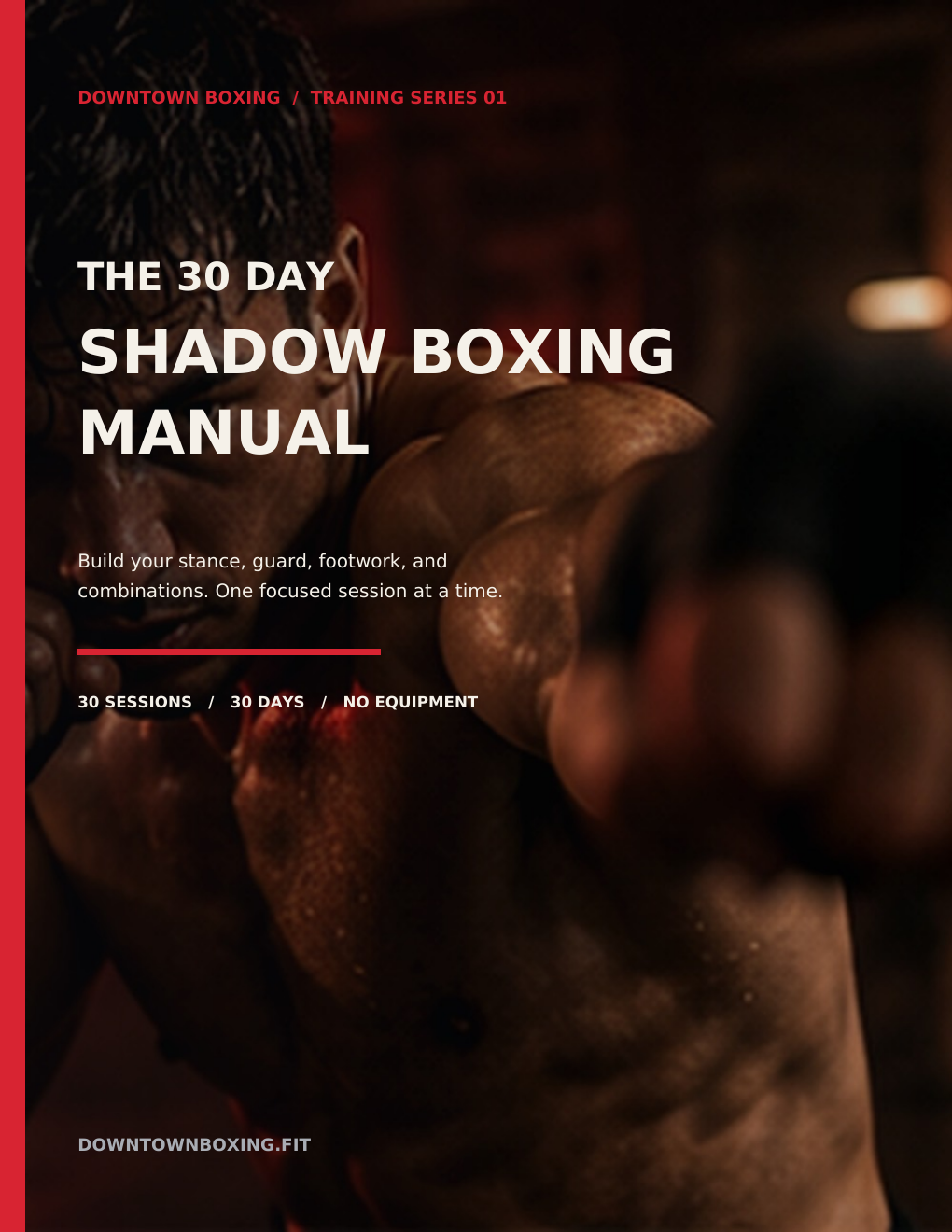
A structured practice companion
The verified 30 Day Shadow Boxing Manual provides 30 no-equipment sessions. Use it to organize appropriate training days, never to override pain, fatigue, coaching, or medical advice.
Disclosure: This is a Downtown Boxing digital product. The promotional link supports the site.
Drill one: jab-cross, guard, lead-side exit
Work in front of a mirror or an empty wall line. Throw a relaxed jab and cross at fifty percent speed. As the cross retracts, confirm the right glove returns to the cheek and the left glove is already home. Push lightly from the inside edge of the right foot, step left with the lead foot, and bring the rear foot along. Do not twist the torso in one direction while the feet travel in another. Hips, shoulders, and stance should finish organized together.
Use six sets of three repetitions with a calm reset between sets. On every third repetition, hold the final position for two seconds. Ask: could I defend a hook, jab again, or change direction without shuffling? If not, shorten the step. Keep breathing; exhale on the punches and let the next breath arrive during the exit. Once the pattern stays clean, use a timer for three one-minute rounds. Accuracy matters more than volume. A quiet shoe sound and steady eye line are better scores than how far you traveled.
Drill two: finish-and-move on the heavy bag
Stand at a range where the jab can reach without leaning. Touch the bag with jab-cross, return the gloves, then step left before the bag swings back through your original lane. Circle just enough to face the center of the bag again. Do not chase it. Let each repetition have a beginning and an end: set, punch, protect, exit, reset. If the bag is moving wildly, reduce power so the drill remains about position rather than impact.
Perform four two-minute rounds. In round one, use only jab-cross-left exit. In round two, use jab-cross-right exit, moving the rear foot first. In round three, choose the open side after seeing the bag’s swing. In round four, add a final jab only after the stance is rebuilt. Rest enough to keep the feet precise. Use the Downtown Boxing schedule to place this work inside a coached session rather than turning every open day into unsupervised volume.
Add a partner without turning it into sparring
A no-contact cue drill teaches the eyes to make a decision. The partner holds focus mitts or simply stands outside punching range. You throw a light jab-cross into the air or mitts. As the cross returns, the partner points left or right. Move first with the foot closest to that direction, restore stance, and show guard. The partner does not punch, chase, or trick you. The purpose is seeing while balanced, not proving reaction speed.
Use short sets of five cues. If you cross the feet, both people pause and reduce speed. If the upper body leans before the step, return to the floor-marker drill. Good partner work has a clear agreement and an easy stop. Beginners should not improvise defensive exchanges without a coach. When ready for supervised progression, explore the Downtown Boxing programs. A coach can adjust direction, distance, and stance for your body and the tactical situation.
Compare the three common exits
| Exit | Best beginner use | Main error |
|---|---|---|
| Lead-side step | Leave the center after a straight combination | Lead foot steps too far and stance stretches |
| Rear-side step | Move toward open space while keeping guard | Lead foot moves first and legs cross |
| Step-back reset | Create range when the lane behind is clear | Feet come together or chin lifts |
No exit is automatically safe. Space, ropes, the other boxer, and your balance decide what fits. The beginner assignment is not to collect many patterns. Own one lateral exit in both directions and one controlled step-back. A pivot can come later under coaching. Choose the smallest movement that clears the line and preserves a usable stance.
A four-week progression that protects technique
Week one is floor markers and shadowboxing at half speed. Week two adds the heavy bag with modest power. Week three adds the no-contact partner cue. Week four mixes exits after two familiar combinations. Keep the number of clean repetitions stable before increasing round length. MedlinePlus advises progressing exercise gradually and avoiding sudden simultaneous increases in frequency, duration, and intensity. That principle fits skill work too: change one demand at a time.
Record one measure after each session: how many repetitions ended in your normal stance without a correction step? Do not score punch power. If quality falls in the second half of a round, shorten the round or extend rest. Fatigue is information, not a command to rehearse sloppy movement. Pair the progression with the beginner rest-day plan. Strong exits come from repeatable posture and attention, not from forcing more movement after the legs stop organizing it.
Your exit-step checklist
- See the target and the available space before moving.
- Finish the punch and return both gloves to guard.
- Move the foot closest to the exit direction first.
- Keep the step short enough to control.
- Let the second foot restore normal stance width.
- Keep knees soft and head level.
- Do not cross, click, or drag the feet together.
- Face the target again before punching.
- Stop the set when balance needs repeated correction.
- Use coached partner work before adding pressure.
Run the checklist during slow repetitions, not in the middle of hard rounds. Eventually the cues should compress into one phrase: hands home, feet out, eyes up. If pain, dizziness, or unusual weakness appears, stop. Technique practice is never a reason to move through warning symptoms.
Frequently asked questions
Should I always exit left after a jab-cross? No. Left is a useful first pattern for an orthodox beginner, but open space, stance matchups, ropes, and coaching determine the direction. How big should the step be? Usually only large enough to clear the immediate line while preserving stance. Start around six inches and adjust with a coach. Can I jump out? Beginners generally gain more control by stepping. Hops can lift both feet and delay the next decision.
When do I punch again? After the stance is rebuilt and you can see the target. Why do my feet cross? You may be moving the far foot first or taking an oversized step. Slow down and use markers. Can I practice alone? Floor and bag drills can be practiced carefully, but live reactions belong in coached settings. What if my knee or ankle hurts? Stop the drill and seek appropriate professional guidance rather than forcing the angle.
Sources and the next coached round
This guide uses conservative skill coaching plus the MedlinePlus exercise-injury guide, which emphasizes warming up, using proper form, gradual progression, rest, and stopping painful exercise. General conditioning should also follow the ACSM physical activity guidance. These sources do not prescribe boxing tactics; the exit mechanics here should be refined in person by a qualified coach who can see your stance and surroundings.
Bring one exit to your next class. Tell Coach Ramon you want the combination graded through the reset, not only through the final punch. You can contact Downtown Boxing or review membership options before visiting. The best finish is quiet: the gloves return, the near foot opens the door, the other foot restores the stance, and your eyes are ready for what comes next.
Coach cues for the final two minutes
Late in a round, simplify the language. Use “home, step, set.” Home means the final glove returns to guard. Step means the foot nearest the open direction moves first. Set means the trailing foot rebuilds stance before another punch. Say the cues at normal volume. Shouting faster does not create faster understanding; it often makes a tired beginner rush the first foot and forget the second.
Reduce punch volume if the exit disappears. A two-punch combination with a balanced finish teaches more than six punches followed by a stumble. Between rounds, identify only one error. If the step is too large, mark a shorter target on the floor. If the hands drop, remove the bag and shadowbox. If the eyes fall, have the coach hold a visual cue. The round should end with one correction the boxer can repeat, not a list too long to use.
Use exits near ropes and corners responsibly
Open-floor exits are the starting point because there is room to learn. Near ropes or a corner, space changes and a preferred direction may be unavailable. Do not practice trapping or escaping another beginner without direct coaching. Instead, mark an imaginary boundary and stop before reaching it. Look over the shoulder only with the eyes and peripheral vision; turning the head away from the target can expose the chin and lose information.
A coach may teach a pivot, tie-up, frame, or direction change for specific situations, but those skills require context and rules. Your solo assignment is simpler: recognize the boundary earlier. If the last combination leaves your heels close to the edge, shorten the attack or choose an exit before contact. Ring awareness begins before the ropes touch your back. Safe practice respects partners, gym space, and the difference between a rehearsed drill and live problem solving.
How to review a round without overcorrecting
After training, write one sentence: “My cleanest exits happened when…” Finish it with an observable detail such as “I kept the first step short” or “I returned the cross before moving.” Then write one next-session cue. Avoid labels like slow, bad, or unathletic. Those words do not tell the feet what to do. A useful review connects a choice to a result.
If video is permitted, watch one round at normal speed and once slowly. Count only exits that finish in stance without a correction step. Do not obsess over appearance or compare yourself with advanced boxers online. Share the clip with your coach when possible, because camera angle can hide stance width and distance. The review is complete when you have one testable cue. Close the video, recover, and let the next coached session provide the next layer.

Gear that supports the work
The verified Downtown Boxing Wall Art five-poster bundle is a digital download with six sizes per design. Let visual cues support a routine, not replace practice or coaching.
Disclosure: This is a Downtown Boxing digital product. The promotional link supports the site.
Finish the round in a position you trust
A clean exit turns a combination from a memorized sequence into a complete boxing action. You arrive balanced, make the punches, protect the return, and leave without giving away your feet. Practice the movement slowly enough to notice the instant the stance becomes too wide or the guard separates. Correct that instant, not the whole round. Precision grows when the feedback is small and immediate.
In the Clearwater gym, ask for space and use it responsibly. Do not race another beginner around the bag or turn a cue drill into surprise contact. Build the pattern, then let coaching add timing and pressure. One dependable exit used at the right moment is worth more than five dramatic movements you cannot control. Finish, move, reset, and see. That is how the combination keeps serving you after the punches stop.
Editorial note: The hero is an original AI-generated image created for this article and reviewed for natural boxing anatomy. Technique and safety guidance were checked against the cited public-health sources.