
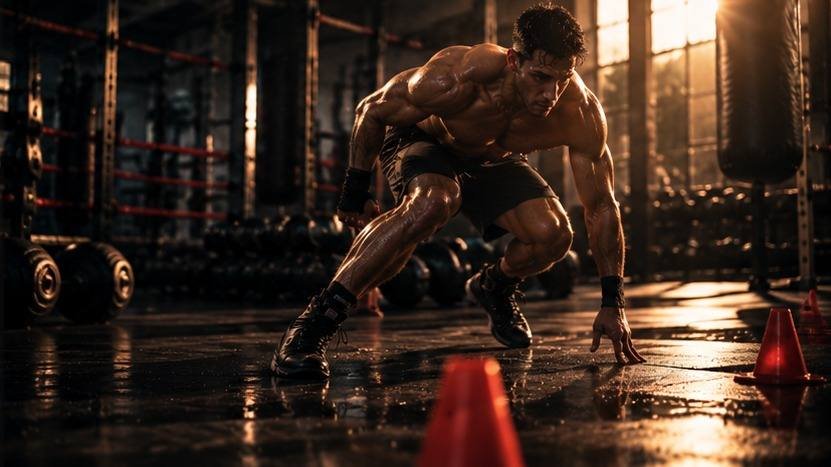
Stopping force is part of producing force
Boxers talk about speed and power, but every fast action also needs a brake. Your body has to stop a punch, pull it back to guard, control rotation, and keep the feet available for the next move. If you only train the ability to push harder, you miss the strength that lets you finish under control.
A cross rotates the trunk and shoulder toward the target. The muscles on the other side help slow and reverse that motion. A step changes momentum. The legs and hips absorb it before you push again. Strength training should support both directions.
Tyler may coach this through strength and conditioning work. Ramon or David may point it out during boxing drills. The language changes, but the outcome is the same. You want to hit, stop, recover, and move without your body spilling past the position.
Try this
- Throw one cross at half speed and freeze on the return.
- Notice what stops your rotation.
- Shadowbox a step in and step out without bouncing.
- Keep the same control as pace increases.
Build strength where the body changes direction
Simple strength exercises are enough. Split squats, squats, hinges, rows, presses, carries, and controlled trunk work all train the body to create and resist force. The important part is repetition quality. Lower the weight under control. Keep joints lined up. Finish the rep without wobbling into the next one.
A split squat is a useful example. You lower under control, stop, then drive up. That bottom position teaches the legs to accept force before producing it. A row teaches the shoulder blade and upper back to control the arm as it comes toward the body. A carry asks the trunk to resist unwanted movement while you walk.
None of these exercises need to look like a punch. Boxing already gives you the sport movement. Strength work gives your body more capacity to manage it.
Try this
- Use a load you can lower for two to three seconds.
- Pause briefly in the hardest controlled position.
- Drive back without losing alignment.
- Stop the set when reps change shape.
Use single leg work for boxing positions
Boxing rarely keeps your weight split perfectly between both feet. You step, pivot, shift, and transfer pressure. Single leg exercises help build control for those moments without pretending to be boxing drills.
Split squats, step ups, and supported single leg hinges expose side to side differences. One leg may shake more. One hip may rotate. One foot may lose pressure. Those are not reasons to chase heavier weight. They are information. Use a range you control and let the weaker side catch up.
Keep the exercise stable enough to train strength. If balance becomes the whole challenge, hold a rack or wall lightly. The goal is to make the leg and hip stronger in positions that resemble moving through a boxing stance.
Try this
- Pick one single leg exercise.
- Use the same reps on both sides.
- Hold support if balance limits the leg effort.
- Progress range or load only after the reps stay clean.
Train the trunk to resist before it twists harder
The trunk transfers force between the legs and upper body. Rotational work has a place in boxing training, but resisting rotation matters too. Carries, dead bug variations, side planks, and anti rotation presses teach you to keep the rib cage and pelvis organized while the arms or legs move.
That control helps when a punch misses, when the bag swings, or when you change direction. You want enough trunk stiffness to keep movement connected without turning every breath into a brace.
Start with positions you can breathe in. If you have to hold your breath for an entire set, the exercise may be too demanding for the goal. Boxing already asks you to manage breathing under effort. Strength work should support that skill.
Try this
- Choose one carry and one anti rotation drill.
- Use short sets with normal breathing.
- Keep the ribs and pelvis stacked.
- Stop before fatigue turns the drill into a twist.
Leave enough strength for boxing
A strength plan fails when it makes every boxing session worse. You should not need three days to recover from a basic gym lift. Start with two short strength sessions per week if that fits your training history and schedule. Put hard work where it does not destroy the skill sessions that matter most.
Track simple signs. Are your legs still responsive in class. Can you keep your guard up. Are you sleeping normally. Do your joints feel better, the same, or worse. These questions matter more than chasing a personal record every week.
At Downtown Boxing, strength and conditioning supports the boxing. Use it to make your stance stronger, changes of direction cleaner, and late round technique easier to hold.
Try this
- Keep the session to a few basic movements.
- Leave one or two reps in reserve on most sets.
- Avoid max effort lifting before a key boxing session.
- Review the plan with a coach after two weeks.
Build strength you can use in the ring
Train the idea with coaching, then judge it by cleaner rounds. See the schedule, review membership, or keep learning in The Boxing Lab.
Downtown Boxing, 936 Cleveland St, Ste C, Clearwater, FL 33755.