
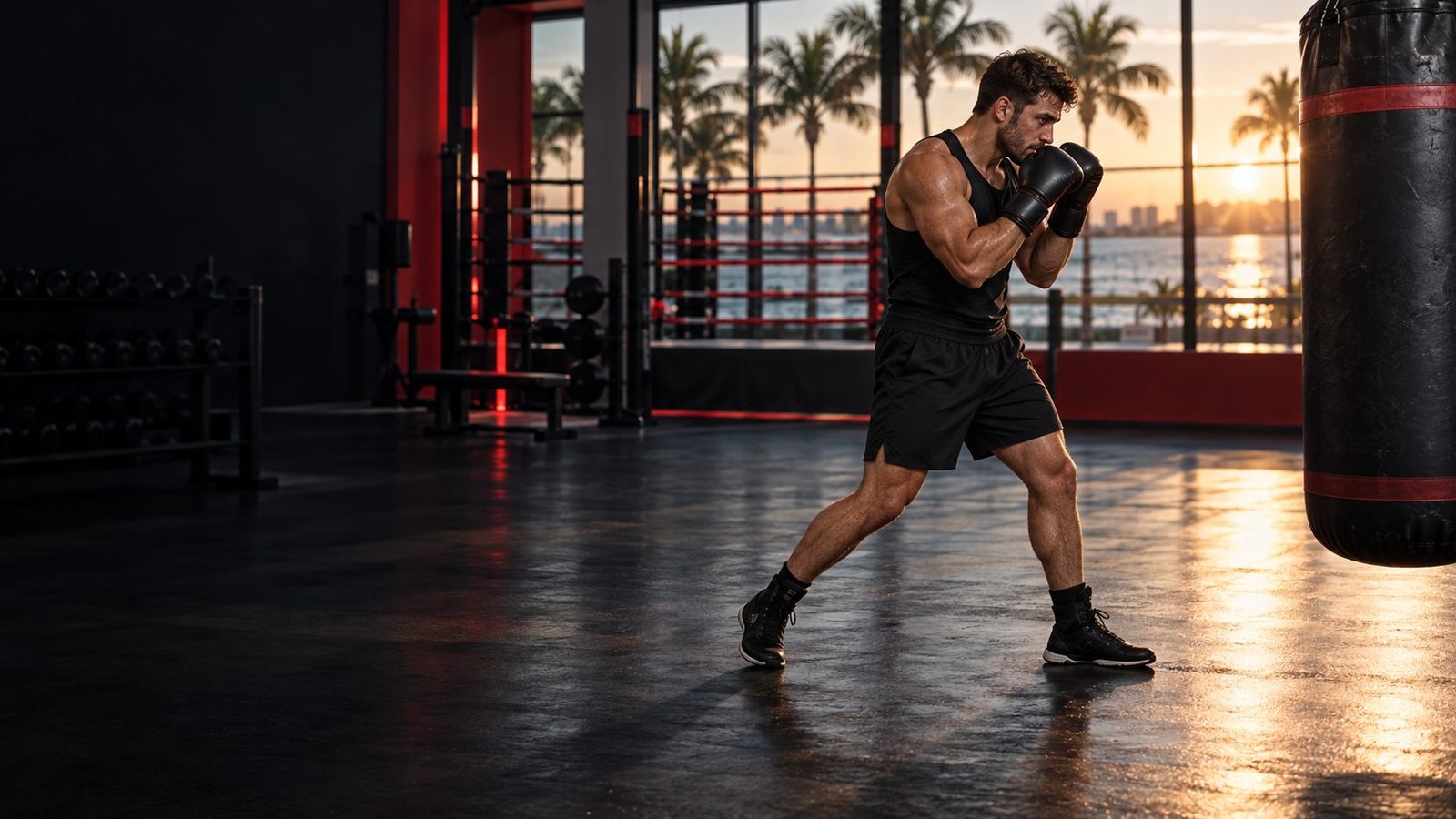
Why the backward step deserves its own practice
Boxing step back footwork gives a beginner a way to leave range without turning away. The purpose is to move your base while keeping your eyes, guard, and balance available. It starts with a decision about distance rather than a race across the floor. Practice the movement without punches before using it near a bag. A coach should be able to see where your feet begin and where they finish.
A beginner often pulls the head away while the feet stay in place. This changes the upper body position without moving the base. Another common response is a long leap which leaves the feet too close together. Both responses make the next action harder to organize. A controlled step asks less of you. Move only far enough to create the space you intended, then stop in a stance from which you could move again.
Imagine a line on the floor in front of your lead foot. It represents the edge of a practice area, not an opponent. Start in guard and step away from that line. Look at a point ahead rather than looking down during the movement. Once you stop, check your feet. Your stance should still have width and length. If the shoes meet or cross, reset and make the next step smaller.
Move the rear foot before the lead foot
In an orthodox stance, the right foot is the rear foot. For a backward step, it moves away first. The left foot then follows enough to restore the stance. A southpaw reverses the feet. Keep the movement small at first so the following foot does not travel past the other one. Your coach can adjust the spacing to suit your body rather than asking you to copy a fixed measurement.
Try the movement as two separate actions. Move the rear foot, pause briefly, and bring the lead foot back to restore your base. Do not hold the pause long enough to turn it into an awkward stretched position. It is a teaching step which lets you notice the sequence. As the order becomes familiar, reduce the pause until both parts belong to one controlled movement.
Avoid dragging the lead foot so far backward that you stand upright with both shoes together. The goal is to preserve a usable stance while changing location. Check whether your knees still feel free to bend. Notice whether you could take another step in a different direction. If you have to rebuild your position before moving, you probably changed the distance between your feet more than intended.
Keep your head over your base rather than throwing it behind your heels. Your upper body should travel with the movement instead of tipping backward first. Let the shoulders stay ready and keep the gloves near your normal guard. You are learning to move away while remaining organized. Speed becomes useful only when the movement still ends in a position you recognize.
Make room before you begin
Choose a clear part of the training floor. Look behind you before starting the set, and make sure you are not stepping toward a wall, another person, or equipment. Do not practice backward travel through a busy walkway. A bag station or marked area gives you a place to repeat the movement without guessing where other people will be. Ask your coach where the drill belongs during class.
Begin with one step and a complete reset. Return to your starting point by walking rather than trying to string together a long sequence. This keeps attention on the skill you are learning. You can add continuous movement after each individual step is repeatable. There is no benefit to traveling across the gym if the first step already leaves you without balance.
Use a floor seam as a reference if one is available. Stand with enough space to move away, take the step, and inspect where your feet landed. The seam helps you see whether you drifted sideways without intending to. It is information rather than a rule requiring every repetition to land on an exact spot. Your stance still needs to fit your body and the action you are practicing.
Keep the guard during the exit
Your hands should not swing to help you balance during a boxing exit. Start with both gloves in the position your coach has taught you. Step away and stop. Check whether either hand dropped as your feet moved. If it did, slow the drill and reduce the step. Trying to solve a balance problem with a more complicated hand movement usually adds another task before the feet are ready.
Keep looking at the reference point in front of you. Do not lift your chin to see over your gloves. If the guard blocks your view, have your coach adjust it. The purpose of the drill is to preserve your ability to observe while moving. A backward step which ends with your eyes pointed at the ceiling does not meet that purpose, even if your feet traveled a long distance.
After the step, pause before doing anything else. Let the pause reveal whether you are balanced or still falling backward. You should not need another unplanned step to catch yourself. If you do, shorten the first movement and check where your weight began. Start again with a stance which feels ready to move instead of leaning back before the rear foot leaves its position.
Connect a jab to the step
Practice a jab into the air, return the hand, and then step back. Keep these as separate parts at first. This lets you notice whether you begin leaving before the hand recovers. Your coach might teach combinations of movement and punching later, but this drill has one clear order. Punch, recover, move, settle. Each part should leave you able to perform the next one without a scramble.
Do five attempts rather than working continuously. After each attempt, ask whether the jab ended under control and whether the step preserved your stance. Count only repetitions which meet both checks. A score of three out of five is a useful starting point. It tells you how many attempts stayed organized. It does not need a story about being good or bad at boxing.
Once the sequence feels consistent, practice near a stationary heavy bag. Find a jab distance your coach considers appropriate. Touch the bag, recover the glove, and step out. Do not push the bag away as a substitute for creating space with your feet. If it starts swinging, stop it between sets or wait for it to settle. Keep the distance problem manageable while learning the exit.
Use three rounds with one purpose each
The first round is movement only. Choose a round length which lets you preserve attention and control. Perform one backward step, stop, and reset. Keep the rear foot first and the lead foot following. Between attempts, release unnecessary tension without lowering your awareness of the training space. Rest before fatigue turns the sequence into a shuffle you cannot observe.
The second round adds the air jab. Recover the hand before stepping. Work in short sets of five and record how many finish with guard and stance intact. Pick one correction during the rest period. It might be shortening the step or keeping the eyes level. Avoid choosing several corrections at once. You need a task you can remember on the first repetition after the break.
The third round uses a light bag touch followed by the exit. Keep the bag movement small and stop between attempts. You are not testing how much force you can produce. You are checking whether contact changes the way you recover and move. If the touch makes you lean, return to the air drill. Remove the demand which is hiding the movement you are trying to learn.
Finish by repeating several movement only attempts. Compare them with the first round. Do the feet follow in the same order without a long pause? Do you finish without taking an extra recovery step? Record what improved and what still needs attention. This gives your next session a starting point instead of requiring you to guess which drill you did and why it mattered.
Correct the mistake you can observe
If your feet come together, look at how far the lead foot follows. It should restore the stance rather than erase its length. Reduce the following movement and stop sooner. Practice beside a floor reference until you can see the difference between moving the stance and collapsing it. Do not force a wider stance than you can use comfortably. Ask your coach to help you find the middle ground.
If you hop, reduce the distance and the urgency. Begin with the rear foot sliding or stepping as your coach directs, followed by the lead foot. Avoid trying to make the whole body leave the floor. The movement should let you stop on purpose. A leap often carries you farther than intended and makes the next change of direction harder to organize.
If you lean backward, check your starting position before changing the step. You might already have your head behind your base. Establish guard, bring the body into balance, and then move. Ask someone qualified to watch from the side. A side view often makes the difference between a body moving backward and a body tipping backward easier to recognize.
If the guard disappears after the jab, remove the bag and practice the return by itself. Extend the hand into the air, recover it, and pause. Add the step only when the hand comes home without another reminder. Breaking the task into parts helps you find which transition is failing. You do not need a longer combination to solve a missing hand recovery.
Know what the drill does and does not measure
A backward step on an open floor is a footwork exercise. It does not prove you will avoid a punch from a partner. Another person changes range and timing, and supervised partner work introduces demands which a floor line cannot provide. Keep your conclusions tied to what you practiced. You learned a sequence and a balanced finish. Your coach decides when and how to add another person.
Do not practice surprise contact with a friend to see whether the movement works. Agree on a drill with a coach and follow its limits. A partner exercise should have a clear purpose, appropriate equipment, and a pace which allows learning. If either person stops understanding the task, pause and clarify it. The goal is to build a skill together, not turn uncertainty into an exchange neither person planned.
Keep a record which changes the next session
Write the drill name and the number of attempts you completed with a balanced finish. Add the correction you used, then note whether it helped. Keep the record small enough to repeat after class. A notebook full of impressions is harder to use than a few observations tied to an action. Your next session should begin with a decision based on what happened rather than a demand to work harder.
For example, record five attempts, three balanced finishes, lead foot followed too far. Your next set starts with a smaller following step. If the result improves, keep that correction for another session before adding speed. If it does not, ask your coach to watch the sequence. The record gives the coach something to investigate without pretending you have already diagnosed the cause.
Review the practice over several sessions. One tired evening does not describe your ability, and one successful set does not mean the movement is automatic. Look for a pattern you can reproduce while following the same checks. When the rear foot leads, the stance stays usable, and the guard remains available, you have evidence to discuss with your coach about the next stage.
Bring a footwork question to class
At Downtown Boxing in Clearwater, bring one observation from your step back practice. Tell your coach whether the feet meet, the guard drops, or the head leans. Ask for one correction you can practice during the next round. A specific observation makes the conversation useful because both of you know what to watch. Review the boxing programs and choose a coached session which fits your experience.
For your next practice, start with a clear space and one backward step. Move the rear foot, let the lead foot restore the stance, and stop with your guard available. Repeat until you can describe what happened without guessing. Then add the jab and its return. Your measure of progress is a movement you can repeat, observe, and correct. Distance traveled is only useful when you remain ready at the end.