
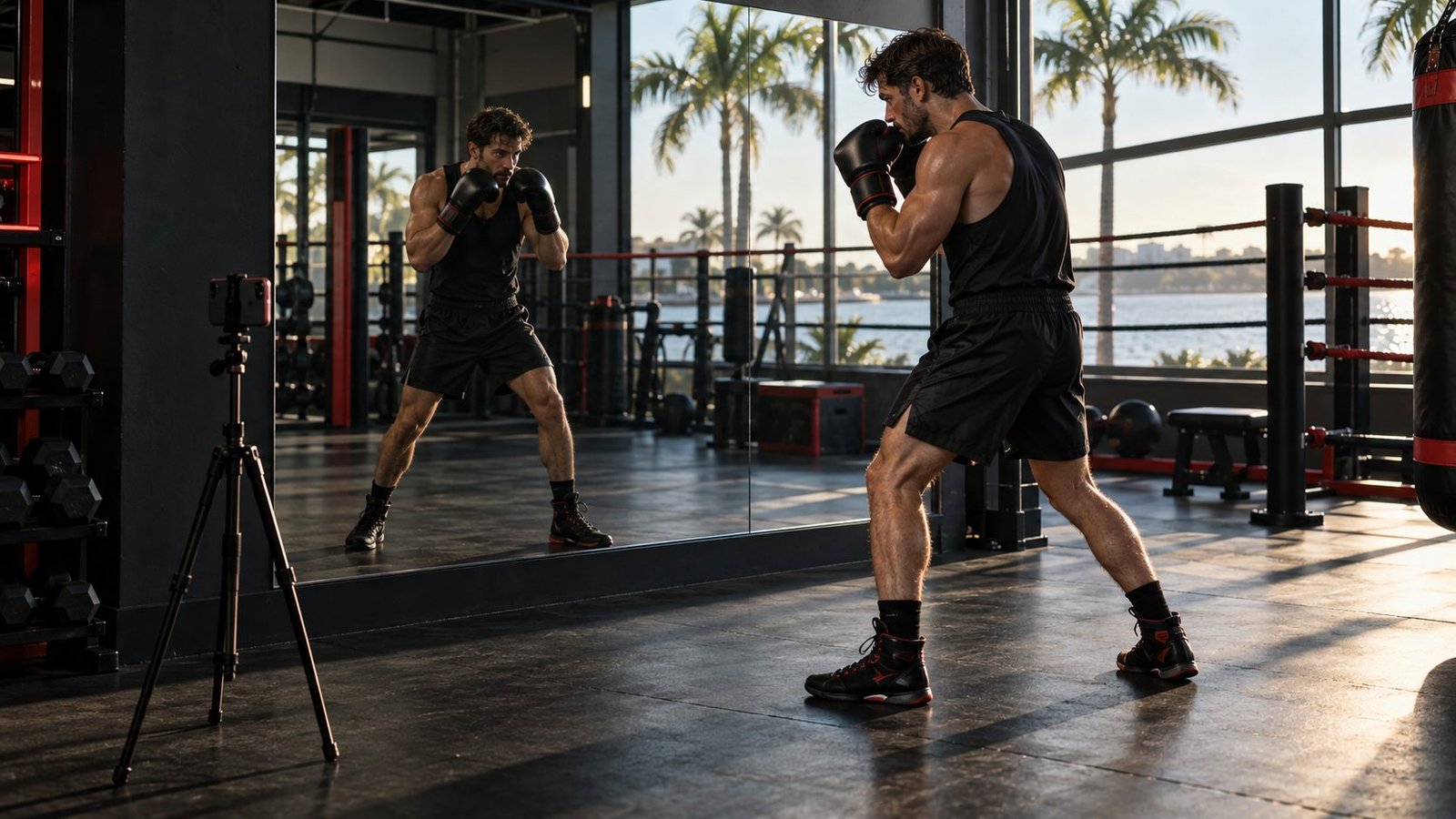
Give the recording one job
Recording your boxing practice is useful when you know what you want to observe. A camera collects movement, but it does not tell you which correction matters. Begin with a question small enough to answer from a short clip. You might ask whether your jab returns to guard or whether your feet come together after a step. Pick one question before pressing record.
A beginner often watches a whole round and sees a dozen things to change. The result is more confusion rather than a better next repetition. Narrowing the task gives the recording a purpose. If you are checking the jab return, watch the hand after contact. Save questions about the rear foot or shoulder position for another clip. You are gathering evidence for practice, not grading your entire boxing ability.
Use video alongside coaching rather than replacing coaching with a screen. A coach knows the purpose of the drill and can see details outside the frame. They can also tell you whether the correction you chose is relevant at your stage. Bring the clip with your question attached. A clear question helps the coach explain what they see and choose a task you can apply during the next set.
Ask before filming in the gym
Check the gym’s filming rules before setting up a phone. Ask where a tripod belongs and whether recording is allowed during the session you attend. Keep other members out of the frame unless they have agreed to appear. A training floor is shared space, and a recording should not turn another person’s class into your background. If privacy is difficult to manage, choose a different place or time.
Put the phone where it will not block a walkway, bag rotation, or access to equipment. Do not place it behind someone who cannot see it. Secure it rather than balancing it on a surface which might move when a bag swings. A recording is not worth interrupting another member’s training. Ask your coach to check the setup before starting if you are unsure where the drill will travel.
Keep your attention on the exercise while moving. Do not reach toward the phone with a glove or turn your head to see the screen during a repetition. Finish the set, return to a neutral position, and then approach the device. If the framing is wrong, correct it between sets. Trying to operate the camera and perform the drill at the same time creates a task neither activity needs.
Show the feet as well as the hands
Frame your whole body when the question involves balance or movement. Include space above the head and below the shoes so an ordinary step does not leave the frame. A clip which cuts off the feet cannot answer whether they crossed. Place the camera far enough away to capture the drill without using a wide angle view which makes the nearest body part look much larger than the rest.
Choose a view which matches the question. A side view helps you observe forward reach and the position of the head over the base. A front angle helps you see whether the stance becomes narrow. Neither view shows everything. Avoid drawing conclusions about a movement hidden by the bag or your own body. Record another agreed angle if the missing detail matters to the coach’s question.
Keep the camera position consistent when comparing attempts. Moving the phone between clips changes how distance and posture appear. Mark a permitted tripod location or remember its relation to a floor seam. Consistent framing does not make the footage a scientific measurement, but it makes ordinary comparisons easier. You can see whether the same action changed without wondering whether the camera simply moved closer.
Record a set you can remember
Start with five repetitions of one drill. Leave a pause between attempts so each has a beginning and an end. A short set is easier to review than several minutes of continuous bag work. You should be able to remember what you were trying to do during each attempt. If the recording includes many unrelated actions, it becomes harder to connect a visible result with the instruction you followed.
Say the purpose to yourself before starting. For example, jab, return, and settle without an extra step. You do not need to perform for the camera. Keep the effort suitable for the skill you are learning. Recording often encourages people to work faster or harder than planned. If you notice this, stop and reset the task. The clip should represent practice you would do even if the phone were absent.
After recording, write down what the set felt like before watching it. Perhaps the third attempt felt balanced or the last one felt rushed. Then compare the feeling with what the video shows. This helps you connect body awareness with an observable action. Avoid assuming the recording proves every feeling wrong. The camera offers one view, and your coach can help interpret the relationship between the two.
Watch at normal speed before slowing down
Play the clip at normal speed once without stopping. Look for the action you chose to observe. Can you identify each repetition and its finish? Does the sequence remain recognizable as a whole movement? A normal speed view gives context before you inspect isolated frames. Starting with a frozen image can make an ordinary transition look like a position you deliberately held.
On the second viewing, pause after each repetition rather than halfway through every movement. Check whether the guard and stance recover. If the question involves a hand return, follow the glove from its extension until it reaches home. Do not jump between unrelated details. Keep the same observation across all five attempts so your notes describe a pattern instead of a collection of impressions.
Slow playback is useful when a transition happens too quickly to follow. Use it to identify the sequence of actions, then return to normal playback. Do not use one frame to diagnose an injury, decide a joint is damaged, or copy an extreme position from another boxer. A training clip is a limited view of motion. Ask a coach about technique and seek qualified care for symptoms rather than treating a phone as an examination.
Describe what happened without guessing why
Write observations which someone else could check. The right glove dropped below the cheek after the jab is more useful than my defense is terrible. The first statement names a movement. The second combines judgment with a conclusion too broad for the clip. Keep the note tied to the drill so it points toward a practice decision rather than a story about your ability.
Separate an observation from an explanation. You might see the feet come together after the third step. You do not yet know whether the cause was the starting stance, step length, fatigue, or misunderstanding the instruction. List the visible result first and ask your coach what to test. Guessing a cause too early can lead you to rehearse a correction which does not address the problem.
Look for repeats across the set. One awkward attempt might reflect distraction or a different starting position. A pattern across several attempts gives your coach more to investigate. Count how many repetitions meet your chosen check without turning the count into a competition. A useful note might say three of five jabs returned before the next step. That gives the next set a specific target and a way to compare it.
Make one correction and record again
Choose the correction with your coach when possible. Keep it short enough to remember while moving. Return the glove before stepping is an instruction you can act on. Fix everything is not. The next set should use the same drill and similar effort so you can tell whether the correction helped. If you add speed, another punch, and a new direction together, the comparison becomes difficult to interpret.
Practice several attempts without recording first. Let the instruction become familiar before adding the camera again. This keeps the device from controlling every repetition of the session. Once the task makes sense, record another set of five from the same position. Watch for the original check. Do not abandon it because you notice another detail which looks more interesting on screen.
Compare the sets with the same question. Did the glove return before the step more often? Did the feet stay separated at the finish? If the change helped, repeat it in another session before adding difficulty. If it did not, show both clips to your coach. A correction which failed to help is information. You do not need to make the movement faster to prove you tried hard enough.
Use a review routine which fits class
Keep filming within the time and space your coach allows. A useful routine is one set before a correction and one set after it. Review briefly between activities rather than standing in a bag station while others wait. Write one note and put the phone away. The purpose is to improve practice, and the recording should take a supporting role in the session rather than becoming the session itself.
When class does not allow review time, record only with permission and watch afterward. Keep the question in your notebook so you do not forget what the clip was intended to show. Bring the observation to your next coached session. Avoid inventing a whole replacement training plan based on a few seconds of footage. Let the coach connect the observation with the program you are already following.
If watching yourself becomes distracting, stop recording for a while. Some sessions need attention on the task and the coach rather than another angle of your body. You are not required to create footage to make progress. Use the method when it answers a practical question. A notebook, a coaching cue, and a set you can repeat remain useful even when the phone stays in your bag.
Keep a small training record
Label the clip with the date and drill in a private training folder. Add the question and the result in a notebook or note beside it. You do not need a complicated scoring system. Record the same check in language you will understand next week. For example, jab return, four of five attempts recovered before the step, repeat at the same pace next class.
Keep only the footage you need to compare progress or discuss a question with your coach. Respect any agreement about other people appearing in recordings. Filming permission does not automatically mean permission to post a clip online. Check before sharing and keep private practice private when another person has not agreed. A training tool works best when everyone around it knows how it will be used.
Review patterns over several sessions rather than judging progress from one clip. Changes in energy, instructions, equipment, and the drill itself affect what you see. Note those differences when they matter. If you change the task, begin a new comparison instead of claiming a score improved under the same conditions. Honest records help your coach make decisions without requiring an explanation for every uneven day.
Turn the clip into your next practice task
At Downtown Boxing in Clearwater, bring one clip and one question to your coach. Ask whether the movement you noticed is the next useful thing to address. The answer might be a correction, a simpler drill, or a reminder to keep practicing the current task. Review the boxing programs if you need a coached starting point. Video becomes useful when it leads to a task you understand and can repeat.
For the next session, choose one drill, record five attempts with permission, and observe one part of the finish. Write what happened before guessing why it happened. Make a correction with your coach and compare another set using the same check. Then return your attention to practice. The goal is not a clip which looks impressive. It is a question answered well enough to guide the work you do next.
Before recording, decide what result would change your next action. If the hand return is consistent, you might keep the drill and discuss adding a step. If it is inconsistent, you might remove the step and rehearse recovery alone. This decision gives the footage a practical role. You are not collecting clips simply because recording is available.
Ask your coach to demonstrate the observation they want you to make. They might point to the position of the glove at the end rather than asking you to watch the whole arm path. Repeat the check in your own words before practicing. Shared language reduces confusion between a movement you see and a correction you think you heard. Keep that wording in the record so the next review begins with the same purpose.