
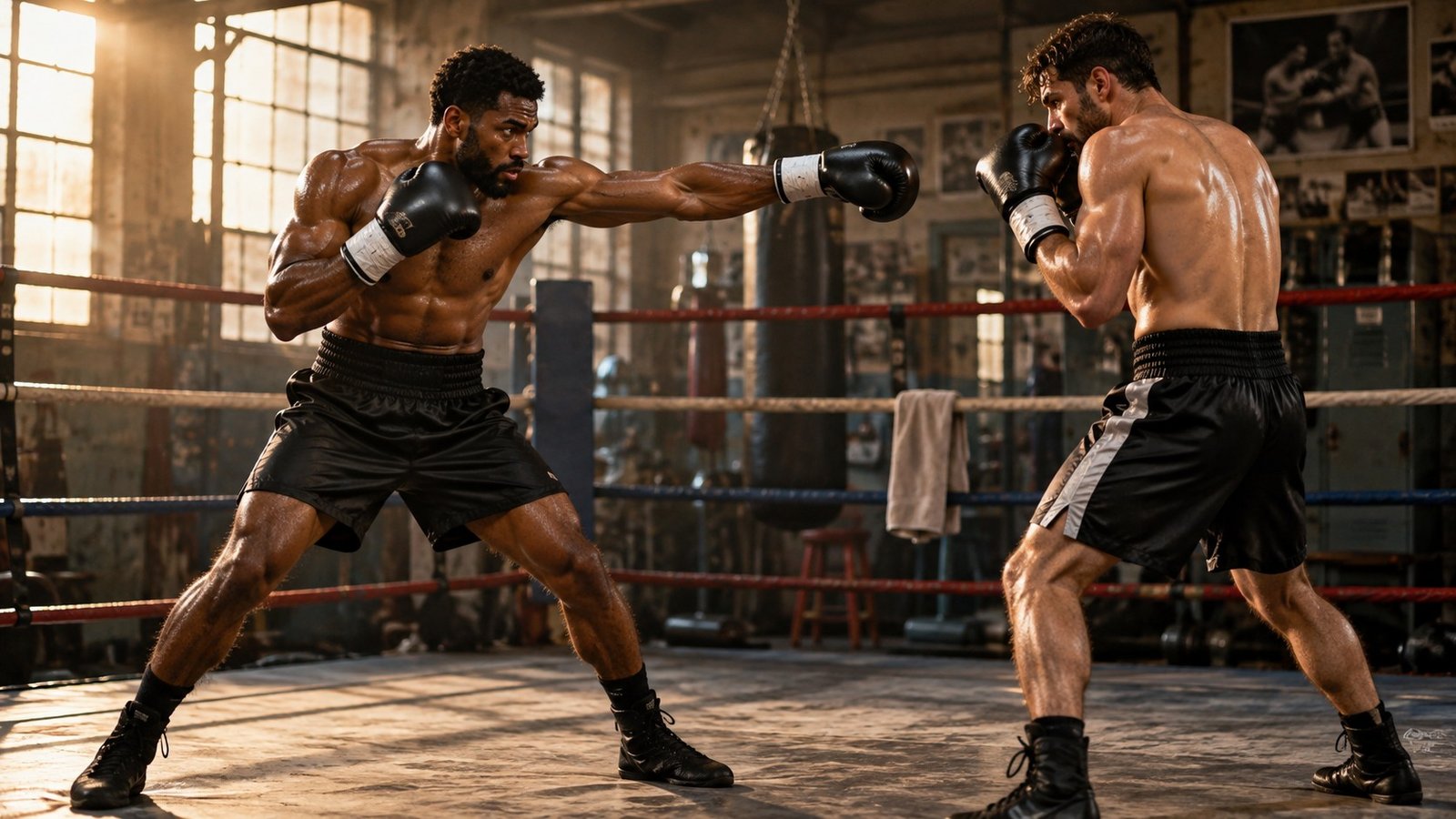
Measure distance before throwing
Your jab begins from a position you can control. Before you extend the lead hand, settle your weight between your feet and notice whether your head sits above your stance. The straightest punch is not helpful if you fall forward to reach the target. Set a marker on the floor and rehearse the same short movement until your feet land in a position from which you can move again.
Distance is a decision, not a fixed measurement. If a heavy bag swings away, do not chase it with a long arm. Allow it to return or use a measured step while keeping the rear foot involved. On shadowboxing rounds imagine a target approaching and retreating. Practice staying patient instead of swinging at empty space with all your force.
Work in short rounds with clear goals. Spend one minute finding your stance, one minute extending and recovering the lead hand, and one minute adding a small step. Rest long enough to notice your breathing and your balance. Add complexity only after the earlier piece feels controlled. Repetition with attention is more useful than rushing to add combinations.
Watch where the punch finishes. The lead shoulder helps protect the chin while the other glove remains ready. Avoid locking the elbow into the target and avoid leaving the jab hanging in front of you. Retract on the same line, return to your stance, and check whether you are ready for another punch or an exit.
Build a stance you can return to
Distance is a decision, not a fixed measurement. If a heavy bag swings away, do not chase it with a long arm. Allow it to return or use a measured step while keeping the rear foot involved. On shadowboxing rounds imagine a target approaching and retreating. Practice staying patient instead of swinging at empty space with all your force.
Work in short rounds with clear goals. Spend one minute finding your stance, one minute extending and recovering the lead hand, and one minute adding a small step. Rest long enough to notice your breathing and your balance. Add complexity only after the earlier piece feels controlled. Repetition with attention is more useful than rushing to add combinations.
Watch where the punch finishes. The lead shoulder helps protect the chin while the other glove remains ready. Avoid locking the elbow into the target and avoid leaving the jab hanging in front of you. Retract on the same line, return to your stance, and check whether you are ready for another punch or an exit.
Ask for a coaching cue when a drill feels confusing. Different body proportions and training backgrounds change how people discover a useful working range. A beginner class is a place to learn the method and receive corrections, not prove toughness. Work with a coach before introducing live contact or partner resistance.
Why reaching makes the jab weak
Work in short rounds with clear goals. Spend one minute finding your stance, one minute extending and recovering the lead hand, and one minute adding a small step. Rest long enough to notice your breathing and your balance. Add complexity only after the earlier piece feels controlled. Repetition with attention is more useful than rushing to add combinations.
Watch where the punch finishes. The lead shoulder helps protect the chin while the other glove remains ready. Avoid locking the elbow into the target and avoid leaving the jab hanging in front of you. Retract on the same line, return to your stance, and check whether you are ready for another punch or an exit.
Ask for a coaching cue when a drill feels confusing. Different body proportions and training backgrounds change how people discover a useful working range. A beginner class is a place to learn the method and receive corrections, not prove toughness. Work with a coach before introducing live contact or partner resistance.
Record a concrete observation after each round. Did your front knee drift too far past the foot. Did your rear heel follow when you stepped. Did you recover the jab without pulling your shoulder out of line. Choose one correction and repeat it. Over time your notes become a map of what practice is teaching you.
Use the front foot to close distance
Watch where the punch finishes. The lead shoulder helps protect the chin while the other glove remains ready. Avoid locking the elbow into the target and avoid leaving the jab hanging in front of you. Retract on the same line, return to your stance, and check whether you are ready for another punch or an exit.
Ask for a coaching cue when a drill feels confusing. Different body proportions and training backgrounds change how people discover a useful working range. A beginner class is a place to learn the method and receive corrections, not prove toughness. Work with a coach before introducing live contact or partner resistance.
Record a concrete observation after each round. Did your front knee drift too far past the foot. Did your rear heel follow when you stepped. Did you recover the jab without pulling your shoulder out of line. Choose one correction and repeat it. Over time your notes become a map of what practice is teaching you.
Your jab begins from a position you can control. Before you extend the lead hand, settle your weight between your feet and notice whether your head sits above your stance. The straightest punch is not helpful if you fall forward to reach the target. Set a marker on the floor and rehearse the same short movement until your feet land in a position from which you can move again.
Make the jab return to guard
Ask for a coaching cue when a drill feels confusing. Different body proportions and training backgrounds change how people discover a useful working range. A beginner class is a place to learn the method and receive corrections, not prove toughness. Work with a coach before introducing live contact or partner resistance.
Record a concrete observation after each round. Did your front knee drift too far past the foot. Did your rear heel follow when you stepped. Did you recover the jab without pulling your shoulder out of line. Choose one correction and repeat it. Over time your notes become a map of what practice is teaching you.
Your jab begins from a position you can control. Before you extend the lead hand, settle your weight between your feet and notice whether your head sits above your stance. The straightest punch is not helpful if you fall forward to reach the target. Set a marker on the floor and rehearse the same short movement until your feet land in a position from which you can move again.
Distance is a decision, not a fixed measurement. If a heavy bag swings away, do not chase it with a long arm. Allow it to return or use a measured step while keeping the rear foot involved. On shadowboxing rounds imagine a target approaching and retreating. Practice staying patient instead of swinging at empty space with all your force.
Train distance with a mirror
Record a concrete observation after each round. Did your front knee drift too far past the foot. Did your rear heel follow when you stepped. Did you recover the jab without pulling your shoulder out of line. Choose one correction and repeat it. Over time your notes become a map of what practice is teaching you.
Your jab begins from a position you can control. Before you extend the lead hand, settle your weight between your feet and notice whether your head sits above your stance. The straightest punch is not helpful if you fall forward to reach the target. Set a marker on the floor and rehearse the same short movement until your feet land in a position from which you can move again.
Distance is a decision, not a fixed measurement. If a heavy bag swings away, do not chase it with a long arm. Allow it to return or use a measured step while keeping the rear foot involved. On shadowboxing rounds imagine a target approaching and retreating. Practice staying patient instead of swinging at empty space with all your force.
Work in short rounds with clear goals. Spend one minute finding your stance, one minute extending and recovering the lead hand, and one minute adding a small step. Rest long enough to notice your breathing and your balance. Add complexity only after the earlier piece feels controlled. Repetition with attention is more useful than rushing to add combinations.
Shadowbox at three ranges
Your jab begins from a position you can control. Before you extend the lead hand, settle your weight between your feet and notice whether your head sits above your stance. The straightest punch is not helpful if you fall forward to reach the target. Set a marker on the floor and rehearse the same short movement until your feet land in a position from which you can move again.
Distance is a decision, not a fixed measurement. If a heavy bag swings away, do not chase it with a long arm. Allow it to return or use a measured step while keeping the rear foot involved. On shadowboxing rounds imagine a target approaching and retreating. Practice staying patient instead of swinging at empty space with all your force.
Work in short rounds with clear goals. Spend one minute finding your stance, one minute extending and recovering the lead hand, and one minute adding a small step. Rest long enough to notice your breathing and your balance. Add complexity only after the earlier piece feels controlled. Repetition with attention is more useful than rushing to add combinations.
Watch where the punch finishes. The lead shoulder helps protect the chin while the other glove remains ready. Avoid locking the elbow into the target and avoid leaving the jab hanging in front of you. Retract on the same line, return to your stance, and check whether you are ready for another punch or an exit.
Learn what a heavy bag teaches
Distance is a decision, not a fixed measurement. If a heavy bag swings away, do not chase it with a long arm. Allow it to return or use a measured step while keeping the rear foot involved. On shadowboxing rounds imagine a target approaching and retreating. Practice staying patient instead of swinging at empty space with all your force.
Work in short rounds with clear goals. Spend one minute finding your stance, one minute extending and recovering the lead hand, and one minute adding a small step. Rest long enough to notice your breathing and your balance. Add complexity only after the earlier piece feels controlled. Repetition with attention is more useful than rushing to add combinations.
Watch where the punch finishes. The lead shoulder helps protect the chin while the other glove remains ready. Avoid locking the elbow into the target and avoid leaving the jab hanging in front of you. Retract on the same line, return to your stance, and check whether you are ready for another punch or an exit.
Ask for a coaching cue when a drill feels confusing. Different body proportions and training backgrounds change how people discover a useful working range. A beginner class is a place to learn the method and receive corrections, not prove toughness. Work with a coach before introducing live contact or partner resistance.
Stepping in without crossing feet
Work in short rounds with clear goals. Spend one minute finding your stance, one minute extending and recovering the lead hand, and one minute adding a small step. Rest long enough to notice your breathing and your balance. Add complexity only after the earlier piece feels controlled. Repetition with attention is more useful than rushing to add combinations.
Watch where the punch finishes. The lead shoulder helps protect the chin while the other glove remains ready. Avoid locking the elbow into the target and avoid leaving the jab hanging in front of you. Retract on the same line, return to your stance, and check whether you are ready for another punch or an exit.
Ask for a coaching cue when a drill feels confusing. Different body proportions and training backgrounds change how people discover a useful working range. A beginner class is a place to learn the method and receive corrections, not prove toughness. Work with a coach before introducing live contact or partner resistance.
Record a concrete observation after each round. Did your front knee drift too far past the foot. Did your rear heel follow when you stepped. Did you recover the jab without pulling your shoulder out of line. Choose one correction and repeat it. Over time your notes become a map of what practice is teaching you.
Exiting after each jab
Watch where the punch finishes. The lead shoulder helps protect the chin while the other glove remains ready. Avoid locking the elbow into the target and avoid leaving the jab hanging in front of you. Retract on the same line, return to your stance, and check whether you are ready for another punch or an exit.
Ask for a coaching cue when a drill feels confusing. Different body proportions and training backgrounds change how people discover a useful working range. A beginner class is a place to learn the method and receive corrections, not prove toughness. Work with a coach before introducing live contact or partner resistance.
Record a concrete observation after each round. Did your front knee drift too far past the foot. Did your rear heel follow when you stepped. Did you recover the jab without pulling your shoulder out of line. Choose one correction and repeat it. Over time your notes become a map of what practice is teaching you.
Your jab begins from a position you can control. Before you extend the lead hand, settle your weight between your feet and notice whether your head sits above your stance. The straightest punch is not helpful if you fall forward to reach the target. Set a marker on the floor and rehearse the same short movement until your feet land in a position from which you can move again.
Balance versus speed
Ask for a coaching cue when a drill feels confusing. Different body proportions and training backgrounds change how people discover a useful working range. A beginner class is a place to learn the method and receive corrections, not prove toughness. Work with a coach before introducing live contact or partner resistance.
Record a concrete observation after each round. Did your front knee drift too far past the foot. Did your rear heel follow when you stepped. Did you recover the jab without pulling your shoulder out of line. Choose one correction and repeat it. Over time your notes become a map of what practice is teaching you.
Your jab begins from a position you can control. Before you extend the lead hand, settle your weight between your feet and notice whether your head sits above your stance. The straightest punch is not helpful if you fall forward to reach the target. Set a marker on the floor and rehearse the same short movement until your feet land in a position from which you can move again.
Distance is a decision, not a fixed measurement. If a heavy bag swings away, do not chase it with a long arm. Allow it to return or use a measured step while keeping the rear foot involved. On shadowboxing rounds imagine a target approaching and retreating. Practice staying patient instead of swinging at empty space with all your force.
How to handle moving targets
Record a concrete observation after each round. Did your front knee drift too far past the foot. Did your rear heel follow when you stepped. Did you recover the jab without pulling your shoulder out of line. Choose one correction and repeat it. Over time your notes become a map of what practice is teaching you.
Your jab begins from a position you can control. Before you extend the lead hand, settle your weight between your feet and notice whether your head sits above your stance. The straightest punch is not helpful if you fall forward to reach the target. Set a marker on the floor and rehearse the same short movement until your feet land in a position from which you can move again.
Distance is a decision, not a fixed measurement. If a heavy bag swings away, do not chase it with a long arm. Allow it to return or use a measured step while keeping the rear foot involved. On shadowboxing rounds imagine a target approaching and retreating. Practice staying patient instead of swinging at empty space with all your force.
Work in short rounds with clear goals. Spend one minute finding your stance, one minute extending and recovering the lead hand, and one minute adding a small step. Rest long enough to notice your breathing and your balance. Add complexity only after the earlier piece feels controlled. Repetition with attention is more useful than rushing to add combinations.
Practice with a coach
Your jab begins from a position you can control. Before you extend the lead hand, settle your weight between your feet and notice whether your head sits above your stance. The straightest punch is not helpful if you fall forward to reach the target. Set a marker on the floor and rehearse the same short movement until your feet land in a position from which you can move again.
Distance is a decision, not a fixed measurement. If a heavy bag swings away, do not chase it with a long arm. Allow it to return or use a measured step while keeping the rear foot involved. On shadowboxing rounds imagine a target approaching and retreating. Practice staying patient instead of swinging at empty space with all your force.
Work in short rounds with clear goals. Spend one minute finding your stance, one minute extending and recovering the lead hand, and one minute adding a small step. Rest long enough to notice your breathing and your balance. Add complexity only after the earlier piece feels controlled. Repetition with attention is more useful than rushing to add combinations.
Watch where the punch finishes. The lead shoulder helps protect the chin while the other glove remains ready. Avoid locking the elbow into the target and avoid leaving the jab hanging in front of you. Retract on the same line, return to your stance, and check whether you are ready for another punch or an exit.
Common errors and simple fixes
Distance is a decision, not a fixed measurement. If a heavy bag swings away, do not chase it with a long arm. Allow it to return or use a measured step while keeping the rear foot involved. On shadowboxing rounds imagine a target approaching and retreating. Practice staying patient instead of swinging at empty space with all your force.
Work in short rounds with clear goals. Spend one minute finding your stance, one minute extending and recovering the lead hand, and one minute adding a small step. Rest long enough to notice your breathing and your balance. Add complexity only after the earlier piece feels controlled. Repetition with attention is more useful than rushing to add combinations.
Watch where the punch finishes. The lead shoulder helps protect the chin while the other glove remains ready. Avoid locking the elbow into the target and avoid leaving the jab hanging in front of you. Retract on the same line, return to your stance, and check whether you are ready for another punch or an exit.
Ask for a coaching cue when a drill feels confusing. Different body proportions and training backgrounds change how people discover a useful working range. A beginner class is a place to learn the method and receive corrections, not prove toughness. Work with a coach before introducing live contact or partner resistance.
Breathing at punching distance
Work in short rounds with clear goals. Spend one minute finding your stance, one minute extending and recovering the lead hand, and one minute adding a small step. Rest long enough to notice your breathing and your balance. Add complexity only after the earlier piece feels controlled. Repetition with attention is more useful than rushing to add combinations.
Watch where the punch finishes. The lead shoulder helps protect the chin while the other glove remains ready. Avoid locking the elbow into the target and avoid leaving the jab hanging in front of you. Retract on the same line, return to your stance, and check whether you are ready for another punch or an exit.
Ask for a coaching cue when a drill feels confusing. Different body proportions and training backgrounds change how people discover a useful working range. A beginner class is a place to learn the method and receive corrections, not prove toughness. Work with a coach before introducing live contact or partner resistance.
Record a concrete observation after each round. Did your front knee drift too far past the foot. Did your rear heel follow when you stepped. Did you recover the jab without pulling your shoulder out of line. Choose one correction and repeat it. Over time your notes become a map of what practice is teaching you.
A beginner round by round routine
Watch where the punch finishes. The lead shoulder helps protect the chin while the other glove remains ready. Avoid locking the elbow into the target and avoid leaving the jab hanging in front of you. Retract on the same line, return to your stance, and check whether you are ready for another punch or an exit.
Ask for a coaching cue when a drill feels confusing. Different body proportions and training backgrounds change how people discover a useful working range. A beginner class is a place to learn the method and receive corrections, not prove toughness. Work with a coach before introducing live contact or partner resistance.
Record a concrete observation after each round. Did your front knee drift too far past the foot. Did your rear heel follow when you stepped. Did you recover the jab without pulling your shoulder out of line. Choose one correction and repeat it. Over time your notes become a map of what practice is teaching you.
Your jab begins from a position you can control. Before you extend the lead hand, settle your weight between your feet and notice whether your head sits above your stance. The straightest punch is not helpful if you fall forward to reach the target. Set a marker on the floor and rehearse the same short movement until your feet land in a position from which you can move again.
Use feedback without chasing perfection
Ask for a coaching cue when a drill feels confusing. Different body proportions and training backgrounds change how people discover a useful working range. A beginner class is a place to learn the method and receive corrections, not prove toughness. Work with a coach before introducing live contact or partner resistance.
Record a concrete observation after each round. Did your front knee drift too far past the foot. Did your rear heel follow when you stepped. Did you recover the jab without pulling your shoulder out of line. Choose one correction and repeat it. Over time your notes become a map of what practice is teaching you.
Your jab begins from a position you can control. Before you extend the lead hand, settle your weight between your feet and notice whether your head sits above your stance. The straightest punch is not helpful if you fall forward to reach the target. Set a marker on the floor and rehearse the same short movement until your feet land in a position from which you can move again.
Distance is a decision, not a fixed measurement. If a heavy bag swings away, do not chase it with a long arm. Allow it to return or use a measured step while keeping the rear foot involved. On shadowboxing rounds imagine a target approaching and retreating. Practice staying patient instead of swinging at empty space with all your force.
Progress through the first month
Record a concrete observation after each round. Did your front knee drift too far past the foot. Did your rear heel follow when you stepped. Did you recover the jab without pulling your shoulder out of line. Choose one correction and repeat it. Over time your notes become a map of what practice is teaching you.
Your jab begins from a position you can control. Before you extend the lead hand, settle your weight between your feet and notice whether your head sits above your stance. The straightest punch is not helpful if you fall forward to reach the target. Set a marker on the floor and rehearse the same short movement until your feet land in a position from which you can move again.
Distance is a decision, not a fixed measurement. If a heavy bag swings away, do not chase it with a long arm. Allow it to return or use a measured step while keeping the rear foot involved. On shadowboxing rounds imagine a target approaching and retreating. Practice staying patient instead of swinging at empty space with all your force.
Work in short rounds with clear goals. Spend one minute finding your stance, one minute extending and recovering the lead hand, and one minute adding a small step. Rest long enough to notice your breathing and your balance. Add complexity only after the earlier piece feels controlled. Repetition with attention is more useful than rushing to add combinations.