
Why accuracy matters
Heavy bag accuracy starts with a target and a repeatable stance.
Choose one target on the bag. Set your feet before each repetition. Return your hands to your guard and pause before starting again.
Start with a target you intend to hit
Heavy bag accuracy for beginners begins before the first punch. Stand in front of the bag and choose a point at shoulder height. Use an existing seam or a mark approved by your coach. Your task is to touch that point with the intended part of the glove while keeping your balance. A loud impact does not prove accuracy. A swinging bag does not prove control. Judge the repetition by where the glove lands and how you finish.
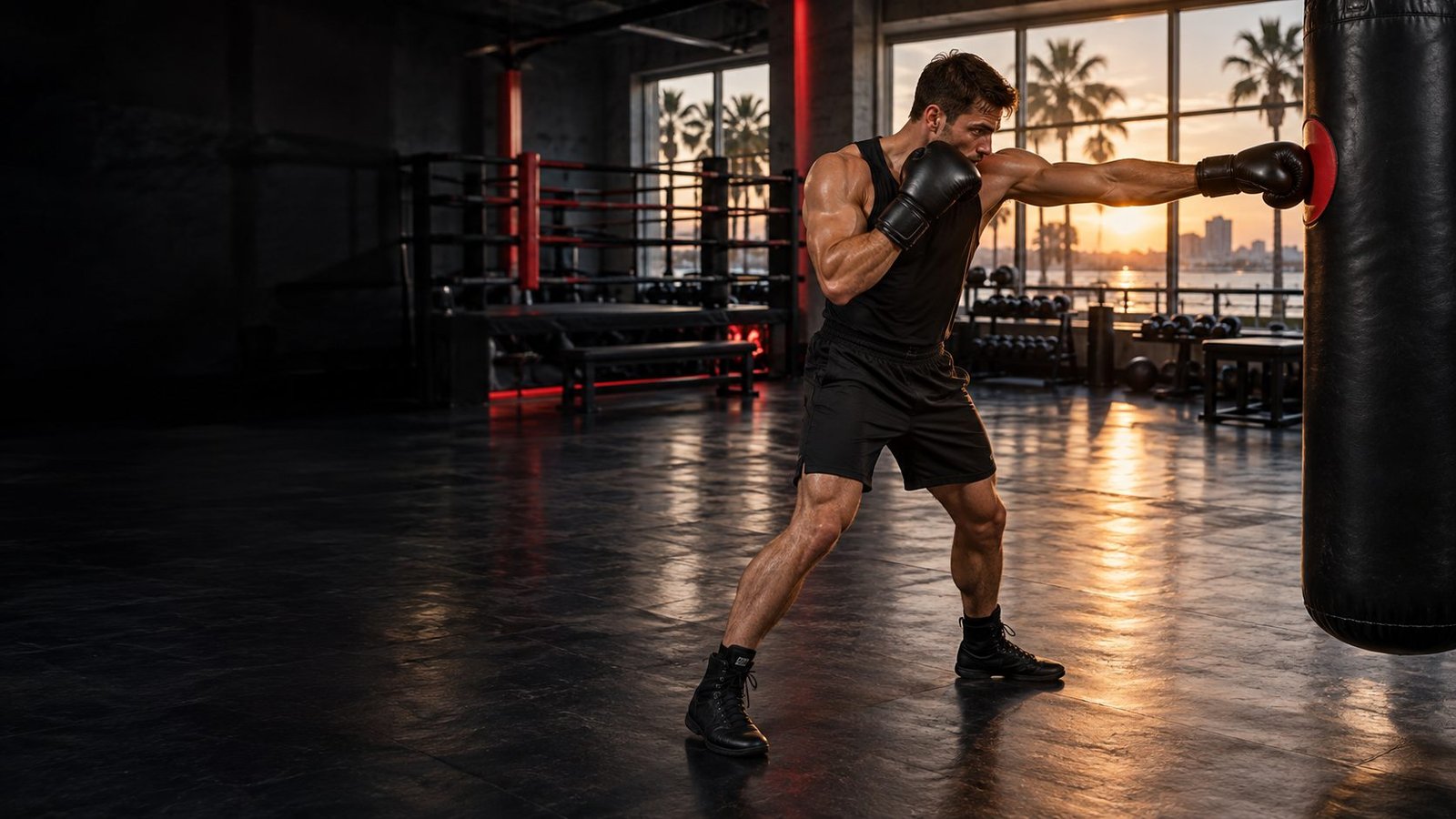
Begin with a jab from your normal stance. Keep the other glove near your cheek. Let the punching hand travel toward the target without lifting your chin to follow it. Bring the glove back along its path. Pause and check your position. If you have to step to avoid falling forward, you reached beyond your range. Move your feet into position before trying again. Do not correct distance by leaning farther over your front knee.
Work at an effort which leaves room to notice mistakes. There is no need to impress the bag. It provides feedback through movement, sound, and the point of contact. You need enough control to recognize each of those signals. Start with individual punches rather than a stream of combinations. A pause between attempts gives you time to identify a miss instead of hiding it inside the next punch.
Build a stance you can return to
For an orthodox stance, place the left foot ahead and the right foot behind. A southpaw reverses those positions. Keep space between the feet rather than standing on a line. Bend the knees enough to move without sinking into a squat. Your coach should help you find a width which suits your body. You should be able to step, stop, and return to guard without crossing your feet.
Look at the target while keeping the chin lowered. Your shoulders should feel ready to move rather than pinned in place. Hold your gloves where your coach has taught you to defend. Avoid pressing both hands together in front of your eyes. You still need to see the bag and the space around it. Between repetitions, release unnecessary tension in the shoulders without dropping your guard.
Before each set, perform a stance check without punching. Shift your position with one step, stop, and look at your feet. Repeat in another direction. If the stance becomes narrow or your feet meet, reduce the step. Accuracy depends on arriving in a position from which your arm has a repeatable path. A stance which changes after every movement makes the target seem inconsistent even when the bag barely moves.
Now add five jabs, one at a time. After each jab, ask whether you could move immediately without reorganizing your feet. If the answer is no, reset before continuing. The purpose is to connect contact with a balanced finish. You are practicing the whole repetition, including recovery, rather than collecting impacts. This makes the next punch easier to place and gives your coach a clearer view of what needs work.
Find range before adding speed
Stand close enough to reach the bag with a jab without locking the elbow or leaning into contact. Start with a touch, recover, then step away. Return and repeat. Notice where your feet stop when the punch feels controlled. That is a reference point, not a permanent location on the floor. Range changes when the bag moves and when you choose a different punch. Learn to judge it rather than relying on one fixed spot.
If the glove brushes the surface without a firm contact, you might be too far away. If your arm feels crowded and the elbow cannot follow its intended path, you might be too close. Ask your coach to watch from the side. Do not solve either problem by throwing harder. Adjust your position by a small step, reset the guard, and try another single jab. Change one thing so you know what helped.
Give the bag time to settle between early sets. A moving bag adds a distance problem before you have established the basic motion. Once you can place five controlled jabs, allow a little movement. Watch it come toward your range, touch the target, and recover. Avoid chasing it with a reaching arm. Step into a suitable position or wait. Patience is part of accuracy because every moment is not a good moment to punch.
Follow the glove through contact and recovery
Keep the wrist aligned with the forearm inside a glove which fits. Have a coach check your wraps and equipment before bag work. Contact should not fold your wrist or force your elbow into a painful position. If it does, stop the repetition and get help with alignment and distance. Do not treat discomfort as evidence of effort. Your goal is a repeatable skill, and practicing a painful motion does not serve it.
When adding the rear straight, let the rear hip and shoulder turn together with the foot movement your coach teaches. Avoid keeping the lower body fixed while twisting only through the upper body. Let the hand return to guard before starting another attempt. The front hand stays available to defend rather than falling toward your waist. Begin with separate rear straights so you can observe the finish without rushing into a combination.
Use a jab followed by a rear straight only after each punch feels organized by itself. Pick the same target for both hands. Pause after the pair and inspect your position. Did the second punch arrive on the intended point, or did it slide across the bag? Did you lose sight of the target? Did your feet move without your intention? Answer one question at a time, then repeat at a pace which allows a correction.
Use a five attempt accuracy score
Give yourself a simple record. Make five attempts with the jab. Count a repetition only when the glove reaches your target, the other hand stays in guard, and you finish balanced. A miss in any part means the repetition does not count. Write down the result without turning it into a judgment of your ability. Three controlled attempts out of five gives you information. It tells you where to begin the next set.
Repeat the set after a pause. Keep the same target and effort so the comparison means something. If the score falls, rest or reduce the pace instead of adding more force. If all five attempts meet your checks, change one variable during the next set. You might add a step before the jab or use the other hand. Do not change target, speed, distance, and combination together. You would lose the ability to identify the source of a miss.
A four round practice session
Use this session as a skill practice with your coach rather than a test of exhaustion. Choose round lengths and rest periods which fit your experience. There is no requirement to complete a competition length round. End a set when you cannot maintain the checks you are practicing. Warm up with movement, shadowboxing, and the preparation your coach recommends. Inspect the space around the bag so another person is not walking through your punching area.
Round one is for the jab. Select one target and work in sets of five attempts. Between sets, reset your feet and relax your shoulders. Record the number which met the target, guard, and balance checks. Use the rest period to name one adjustment. It might be standing closer or waiting longer for the bag to settle. Keep that adjustment specific enough to apply on the first attempt of the next round.
Round two is for the rear straight. Practice individual attempts with a pause between them. Keep the front glove in position and allow the body to turn as a unit. Notice whether your head moves beyond your base as you reach. If you finish crowded against the bag, adjust the starting position. If the bag swings away, wait for it rather than following with a hurried punch. Your record still measures quality rather than volume.
Round three combines the jab and rear straight. Begin with a pair, recover, then move away under control. Return to range before the next pair. You do not need to stay in place and exchange imaginary punches with the bag. Use the pause to see whether both gloves found the target. Keep combinations short enough to remember what happened. If the second hand keeps missing, return to individual rear straights for the rest of the round.
Round four adds a step before the jab. Move your feet, establish your base, and then punch. At first, separate the step from the strike with a brief pause. Your coach can help you combine them as control improves. Avoid crossing the feet or allowing the rear foot to trail so far behind you cannot recover. Finish with several attempts at the original stationary drill. Compare the feeling with round one without expecting perfection.
What to change when you miss
A glove which lands outside the target might reflect the path of your arm, your starting position, or the movement of the bag. Do not assume every miss has the same cause. Freeze after a controlled repetition and ask your coach what they observed. When practicing alone, stop the bag and repeat at a slower pace. Check whether the miss occurs even without bag movement. This separates a path problem from a timing problem.
If your guard drops after contact, shorten the set. Return the glove before doing anything else. Avoid adding a defensive move until you can recover the hand without thinking through several extra actions. If your chin rises as the glove extends, choose a target you can reach without tilting your head. The bag should not draw your face upward. Keep your eyes available and your neck in a position your coach considers appropriate.
If your stance becomes narrow after a combination, practice the combination without the bag. Shadowbox the pair, stop, and inspect your feet. Remove speed until you can repeat the movement with your base intact. Then return to a light touch on the bag. This is a useful way to reduce the number of things competing for attention. The absence of impact helps you notice whether you are stepping unintentionally or turning beyond your balance.
Progress without losing the skill
Keep a record over several sessions before deciding a drill is too easy. Note the target, hand, round length, and the quality score from one set. Add a sentence about the correction which helped. A record such as four of five jabs with a balanced finish tells you more than a claim of working hard. It also helps your coach choose the next task. Bring the record to class and ask what should change first.
Progress by adding one demand at a time. Begin with a target which stays still. Add a step when you can repeat the contact. Add a second punch after each hand has a reliable path. Add bag movement only when you can judge range without reaching. There is no deadline for these stages. Returning to an earlier drill is useful when fatigue or a new movement causes the original problem to return.
Accuracy on a heavy bag does not prove you are ready for sparring. The bag does not choose its own movement or respond to your guard. Partner training requires supervision, appropriate equipment, and agreement on the task. Use bag work to develop habits which support coached training. Keep your expectations tied to the drill you performed. Placing a jab on a marked point is an achievement in that task, and it gives you a foundation to build upon.
Bring one question to your next class
At Downtown Boxing in Clearwater, use your next session to get feedback on one part of the repetition. Ask whether you are standing at the right distance, recovering the hand, or keeping your base after contact. A question tied to one observable action is easier to answer and practice. Review the boxing programs and choose coached practice which fits your experience. Bring your gloves, your record, and a willingness to slow the movement down.
Your goal for the next bag session is clear. Choose the target before throwing, find your range with your feet, and finish ready to move. Count repetitions which meet those checks. Rest when the checks disappear. Over time, the target becomes a way to measure control rather than an excuse to swing harder. Finish the session knowing what you practiced and which correction you intend to repeat when you return.